
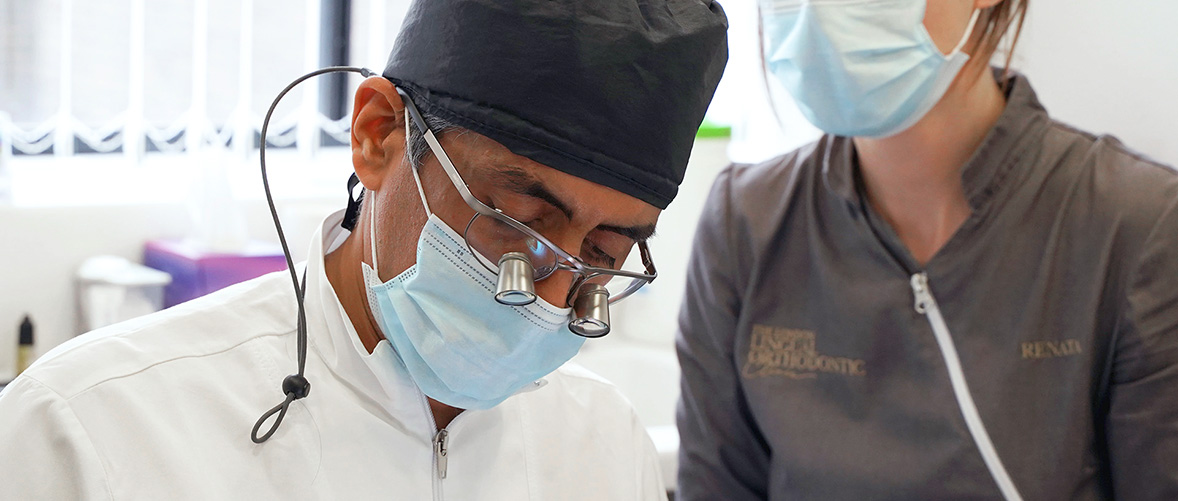
Lingual braces are best known for being discreet – but their clinical range goes much further than many people realise.
What Do We Mean by a Complex Case?
Complexity in orthodontics can mean different things. It might refer to the severity of the tooth movement required, the nature of the bite problem, the presence of other dental conditions that need to be factored into treatment planning, or a combination of all three.
Some of the most common presentations that might be considered complex include:
Significant crowding or spacing – cases where teeth are severely misaligned or where there are large gaps that need to be closed with careful tooth movement.
Deep overbite – where the upper front teeth overlap the lower teeth excessively, sometimes to the point where the lower teeth bite into the palate. This requires precise control of vertical tooth movement throughout treatment.
Overjet – where the upper front teeth protrude significantly in front of the lower teeth. Correcting this involves moving the upper teeth back and often the lower teeth forward simultaneously.
Crossbite – where some upper teeth sit inside the lower teeth rather than outside. This can affect individual teeth or a whole section of the bite and requires careful correction to avoid long-term problems.
Open bite – where a gap remains between the upper and lower teeth when the mouth is closed. Open bites can in many cases be addressed effectively with lingual braces.
Cases requiring jaw surgery – for patients whose bite problem has a significant skeletal component, orthodontic treatment alone may not be sufficient. In these cases, lingual braces are often used in combination with orthognathic surgery, both to prepare the teeth before surgery and to refine the result afterwards.
Why Lingual Braces Lend Themselves to Complex Treatment
Fixed appliances give your orthodontist a level of control over tooth movement that is difficult to replicate with removable options. With lingual braces, each bracket is bonded directly to the inside surface of the tooth, allowing precise three-dimensional movement of both the crown and the root. This precision is particularly valuable in complex cases, where multiple simultaneous movements need to be carefully coordinated.
At The London Lingual Orthodontic Clinic, all fixed cases are treated using SureSmile – a digital planning system that uses 3D imaging and robotically bent wires to deliver highly precise treatment. In Dr Asif Chatoo’s experience, this is particularly beneficial in the finishing stages of complex cases, where the finest adjustments make the difference between a good result and a great one.
Combination Cases
Not every complex case is treated with a single appliance. Some patients benefit from a combination approach – for example, lingual braces on one arch and clear aligners or labial braces on the other. Coordinating two different appliances requires careful planning, and SureSmile’s digital platform is particularly well suited to this, allowing both arches to be planned together with a high level of precision.
The Role of Interdisciplinary Treatment
Some complex cases require input from other specialists. Patients with gum disease or bone loss may need to work with a periodontist before or during orthodontic treatment. Those requiring jaw surgery will be treated alongside an oral and maxillofacial surgeon. Dr Chatoo has extensive experience managing these interdisciplinary cases and works closely with a network of trusted colleagues when combined treatment is the right approach.
Discreet Treatment for Longer Cases
Complex cases often take longer to treat – and for some patients, the prospect of wearing visible braces for an extended period is what puts them off seeking treatment altogether. Lingual braces remove that concern entirely. Being completely hidden from view means treatment can run its course without affecting professional or personal life, however long it takes.
The Importance of a Thorough Assessment
Lingual braces can treat most of the cases that fixed braces can – so if you’re a candidate for fixed orthodontic treatment, you’re likely a candidate for lingual braces too. The only way to confirm this is through a proper clinical assessment – a detailed examination of your teeth, bite, and jaw, supported by X-rays and 3D digital scans.
It’s also worth knowing that straightening teeth and correcting a bite are not always the same thing. A treatment plan that focuses only on the visible result, without addressing the underlying bite, can create new problems while appearing to solve the original one.
Retention After Complex Treatment
Retention is important after any course of orthodontic treatment, but it matters most after complex cases, where significant tooth movements have been made and the risk of relapse is greater. At LLOC, retainers are built into every treatment plan from the outset – both fixed retainers bonded discreetly to the back of the teeth, and removable retainers worn at night.
Experience Matters More in Complex Cases
The more complex the case, the more the experience of the clinician matters. Lingual braces are placed on the inside surface of the teeth – a technically demanding position that requires precision and skill at every appointment.
Dr Chatoo founded LLOC in 2005 as the first practice in the UK dedicated exclusively to lingual orthodontics. He was a founding member of the British Lingual Orthodontic Society and is the first UK orthodontist to be accredited by both the European and World Societies of Lingual Orthodontics. He has served as President of the European Society of Lingual Orthodontics and has lectured internationally on lingual orthodontics and digital technology in orthodontics.
Find Out What’s Possible
If you have a complex case and would like to understand your options, we’d be delighted to hear from you. Arrange a consultation with Dr Chatoo at our private practice on Harley Street.